
Quick Answer
Multi-Signal Validation is an account-level intent methodology. Instead of scoring isolated contacts, Salesbox reads buyer interactions as coordinated patterns across the entire buying committee, blends first-party and third-party evidence across 6 unified signal channels, and requires 2 verified interactions before an account is designated sales-ready — with a 100% documented evidence trail attached to every hand-off.
Every revenue team can monitor engagement metrics: clicks, email opens, content downloads, and website visits. What most legacy GTM architectures fail to achieve, however, is proving whether any of those interactions reflect genuine buying intent.
The consequences of this operational gap are significant. At any given moment, roughly 5% of a target B2B market is actively in-market, according to research from the Ehrenberg-Bass Institute for Marketing Science. The remaining 95% of dashboard activity comes from researchers, competitors, passive browsers, or contacts who will not be in a purchasing cycle for months.
Salesbox's multi-signal validation approach bridges this gap. By reading buyer interactions as coordinated patterns across an entire organization, blending first-party and third-party evidence, and requiring verified two-touch confirmation, revenue teams can accurately isolate true buying signals from background noise.

verified interactions required before an account is designated as sales-ready
unified signal channels integrated into a single account-level feed
documented evidence trail attached to every validated account hand-off
The Fundamental Problem: Engagement Is Not Evidence
An isolated click is not a buyer. Neither is a whitepaper download, a webinar registration, or a single visit to a pricing page. Each interaction could represent early-stage curiosity, a student conducting research, a competitor analyzing messaging, or accidental traffic.
Most go-to-market systems struggle to differentiate between these scenarios. This is not due to a scarcity of data, but rather because traditional frameworks collapse complex buying group behavior into a single numerical score assigned to an individual contact.
That point-scoring model has become increasingly obsolete as decision-making structures have expanded. According to Forrester's State of Business Buying research, the typical B2B purchasing decision now runs through 13 internal stakeholders and 9 external influencers. Assigning a single lead score to an individual contact fails to represent a 22-person evaluation process.
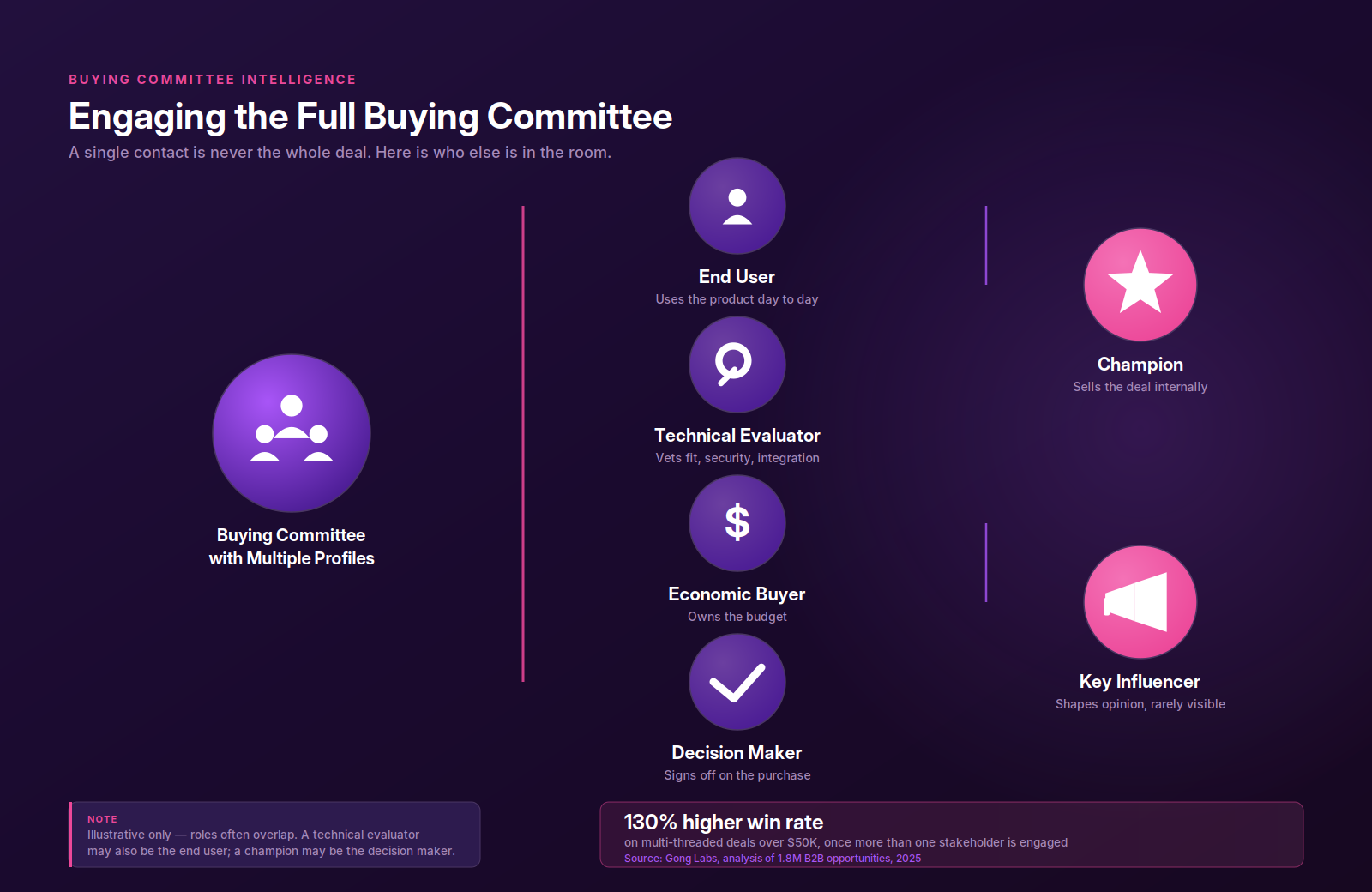
Salesbox's Multi-Signal Validation addresses this structural flaw by evaluating interactions collectively at the account level, refusing to designate an account as sales-ready until corroborated pattern thresholds are met.
How Multi-Signal Validation Works
1. Layer Continuous Signals over Target Account Lists
Static Ideal Customer Profile (ICP) and Account-Based Marketing (ABM) lists define which accounts to monitor, but they do not reveal timing or urgency. Salesbox layers continuous signal capture — spanning professional social networks, search engines, display networks, third-party communities, and owned web properties — turning a static account roster into a dynamic, intent-aware target list.
2. Evaluate Behavioral Patterns Across the Account
Single interactions provide weak intent evidence. Comprehensive deal analyses by Gong Labs, evaluating 1.8 million B2B opportunities, revealed that closed-won deals feature roughly twice as many engaged buyer contacts as lost deals. Furthermore, multi-threaded deals close at up to 130% higher win rates on opportunities exceeding $50K. While conversation analysis platforms like Gong track multi-threading after meetings occur, Salesbox applies that exact multi-threaded insight to the top of the funnel — identifying and engaging multiple decision-makers before reps ever make a cold call.
3. Blend First-Party and Third-Party Intelligence
First-party signals — such as pricing page visits, repeat domain engagement, and technical documentation reviews — offer high-confidence insights into owned digital spaces. Salesbox weights these alongside third-party signals, such as category search volume spikes and review site interactions, providing a full-funnel view: moving from early market awareness, through active category evaluation, to commercial readiness.
4. Require Double-Touch Verification
To eliminate false positives, engagement must be verified through a mandatory second interaction:
- Accessing a high-value, specialized technical asset
- Completing an interactive ROI or total-cost-of-ownership (TCO) calculator
- Submitting an AI-guided micro-survey
- Engaging in a direct, interactive conversation channel
Only after completing this second confirmation touchpoint does Salesbox escalate an account to active sales outreach.
5. Deliver Accounts with Contextual Proof
When an account is routed to sales reps, Salesbox attaches a documented evidence log: specific signals triggered, key stakeholders involved, topics explored, and the explicit verification step completed.
Why Buying Committee Alignment Outperforms Individual Lead Scoring
Focusing on individual contact behavior overlooks the internal dynamics that dictate deal outcomes. Gartner's research into B2B buying behavior revealed that 74% of B2B buying groups experience 'unhealthy conflict' during the vendor evaluation process. Conversely, buying groups that establish genuine internal consensus are 2.5 times more likely to achieve a high-value transaction outcome.
Tracking an entire committee — identifying who is actively engaged, mapping topic convergence, and evaluating alignment — serves as a far more reliable predictor of pipeline success than tracking isolated form submissions.
Traditional Lead Scoring vs. Multi-Signal Validation
| Traditional Lead Scoring | Salesbox Multi-Signal Validation |
|---|---|
| Scores single contacts in isolation | Evaluates collective account behavior across stakeholders |
| Triggers based on arbitrary point thresholds | Requires corroborated, multi-channel behavioral patterns |
| High false-positive rate from casual web browsing | Filters noise using double-touch verification steps |
| Delivers basic contact info without context | Delivers comprehensive account evidence logs to sales reps |
Transitioning to Signal-Driven Operations
Cold outreach based on isolated lead generation creates sales friction and low response rates. Adopting a multi-signal, validated approach changes the nature of sales conversations:
Traditional Hand-off
A name, an email address, and a generic form-submit notification.
Validated Hand-off
Full context on triggered account signals, stakeholder involvement, topic affinity, and verified intent confirmation.
Validating intent through multi-threaded committee signals reduces false positives, improves sales velocity, and ensures go-to-market teams focus bandwidth exclusively on high-probability opportunities.
Frequently Asked Questions
What is Multi-Signal Validation?
Multi-Signal Validation is an account-level intent methodology that evaluates buyer interactions collectively across an entire organization instead of scoring individual contacts in isolation. Salesbox requires corroborated, multi-channel behavioral patterns — including a mandatory second verification touchpoint — before designating an account as sales-ready.
Why does Salesbox require 2 verified interactions?
A single interaction could represent early-stage curiosity, a student, a competitor, or accidental traffic. Requiring a second, higher-intent interaction — such as completing an ROI/TCO calculator, accessing a specialized technical asset, submitting an AI-guided micro-survey, or engaging in a direct conversation — filters out false positives so sales teams only engage genuinely in-market accounts.
How is this different from traditional lead scoring?
Traditional lead scoring assigns arbitrary point thresholds to individual contacts, producing a high false-positive rate from casual web browsing and delivering basic contact info without context. Multi-Signal Validation evaluates collective account behavior across the buying committee, requires multi-channel corroboration, and delivers a documented evidence log with every hand-off.
Which signal channels does Salesbox unify?
Salesbox integrates 6 unified signal channels into a single account-level feed — spanning professional social networks, search engines, display networks, third-party communities, owned web properties, and review sites — blending first-party and third-party intelligence into one full-funnel view.
What does sales receive when an account is handed off?
Every validated account hand-off includes a 100% documented evidence trail: the specific signals triggered, key stakeholders involved, topics explored, and the explicit verification step completed — so reps open conversations with full context instead of a generic form-submit notification.
Sources
- LinkedIn B2B Institute & Ehrenberg-Bass Institute: The 95/5 Rule — Why B2B Growth Starts Long Before the Purchase
- Forrester Research: State of Business Buying Research
- Gong Labs: Analysis of 1.8M B2B Opportunities & Multi-Threading Impact
- Gartner: B2B Buyer Team Conflict & Consensus Dynamics Research
Salesbox Intent unifies account- and contact-level signals across channels into one validated, evidence-backed view of who is really in-market.
Explore Salesbox IntentTurn Buyer Signals Into Sales-Ready Accounts
Want to see how Salesbox brings signals, buying-group intelligence, and GTM execution together in one platform? Explore the Salesbox GTM Platform to see how signal-driven intelligence can help your team identify, validate, and act on real buying intent.